Boom Sprayer vs Cannon Sprayer: Which One Does Your Farm Actually Need?
- Jun 15
- 5 min read
Spraying is one of those jobs that looks simple until the season gets busy. The crop needs protection. The weather is changing. Labour is limited. The field is wet in some areas and dry in others. You need to cover enough ground without wasting chemical, fuel, or time. That is where the right sprayer makes a real difference.
For farmers in Guyana, two common options are the boom sprayer and the cannon sprayer. Both are used for crop protection, but they are made for different types of farms and different spraying needs.
A boom sprayer is usually better for wide, open fields where even coverage matters most. A cannon sprayer is usually better for orchards, taller crops, field edges, and areas where spray needs to reach farther from the machine. The question is not which one is better. The better question is: which one fits your farm?
What does a boom sprayer do?
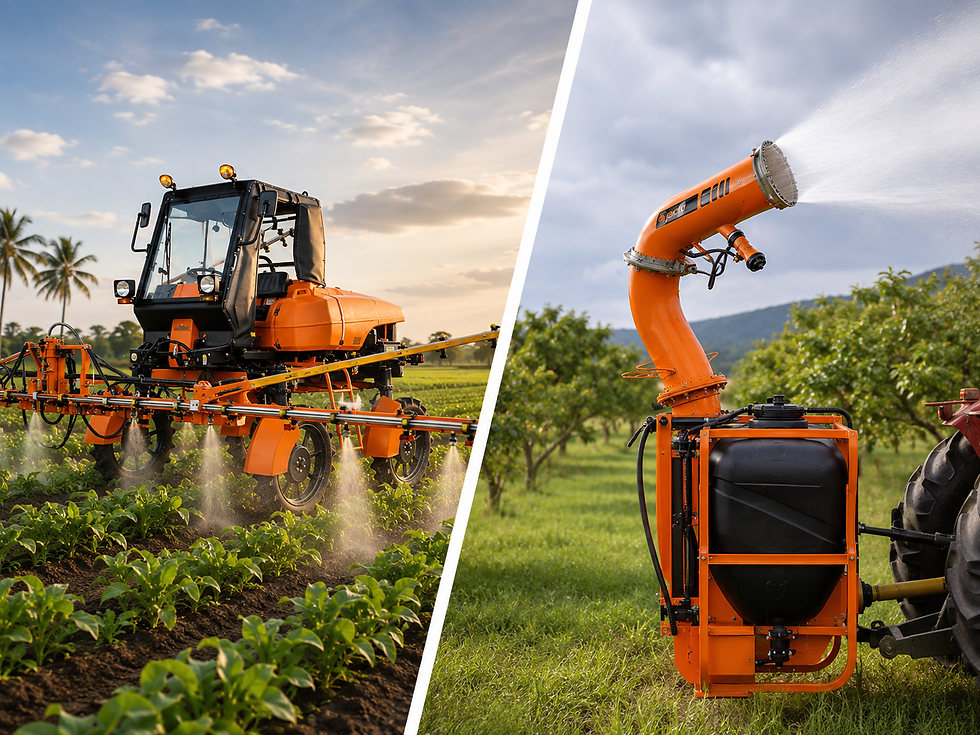
A boom sprayer uses a long horizontal boom fitted with multiple nozzles. As the machine moves through the field, the nozzles release spray in a controlled pattern across the crop. This makes the boom sprayer a strong choice for farmers who need uniform coverage over a wide area. For example, the Shaktiman Protektor 900 Boom Sprayer comes with a 16-metre spray width, 900-litre tank, 22 HP engine, 1.08-metre ground clearance, 4WD, 4-wheel steering, 32 nozzles, and 150 L/min output. Those numbers matter in the field.
A wider spray width means fewer passes. A larger tank means fewer refills. Good ground clearance helps the machine move through crops with less disturbance. Four-wheel drive and four-wheel steering help with control, especially when field conditions are not perfect. For large farms, those details can save hours over a spraying cycle.
When does a boom sprayer make sense?
A boom sprayer is usually the better fit when your farm has open, fairly even fields.
It works well for:
Rice fields
Vegetable farms
Cash crops
Large flat plots
Broad-acre spraying
Herbicide and pesticide application
Liquid fertilizer application
The main advantage is consistency. If the crop is planted in rows or across an open field, the boom can apply spray evenly across a wide area. That helps reduce missed strips and heavy overlap. It also helps operators maintain a more predictable application rate.
This matters because chemical cost adds up quickly. Too little product can leave parts of the crop exposed. Too much product wastes money and can damage the crop. A boom sprayer helps keep that balance under better control.
What does a cannon sprayer do?
A cannon sprayer works differently. Instead of using a long boom with many nozzles, it uses a powerful air-assisted spray system to project mist over a longer distance. The spray direction can be adjusted depending on the area being treated.
The Jacto AJ401 Cannon Sprayer, for example, features a 360-degree rotating cannon, up to 30 metres of long-range coverage, a 105-gallon tank, adjustable spray direction, and targeted application.
That makes it useful in places where a boom sprayer would not be practical. A cannon sprayer is about reach. It can direct spray into taller crops, along field edges, around orchards, and toward areas where the machine may not be able to drive directly.
When does a cannon sprayer make sense?
A cannon sprayer is usually the better choice when your farm has crops or areas that need spray to travel upward, outward, or into harder-to-reach places. It works well for:
Orchards
Tree crops
Tall vegetation
Perimeter spraying
Field edges
Uneven areas
Crops with dense foliage
Areas where machine access is limited
For farms with fruit trees, coconut, mixed crops, or boundary vegetation, a cannon sprayer can be more practical than a boom. A boom sprayer spreads spray evenly across a fixed width. A cannon sprayer lets the operator aim the spray where it needs to go. That difference matters when the crop is not low and uniform.
Think about your farm layout
Before choosing a sprayer, look at your farm layout.
Do you have large open fields?
Do you have trees or tall crops?
Are your plots narrow or wide?
Are there drains, trenches, or uneven areas?
Can the machine easily pass through the crop?
Do you need to spray field edges or boundaries often?
The machine should match the way your land is arranged. A farmer with wide open fields may lose time using a cannon sprayer for work that a boom sprayer could finish faster. A farmer with orchards or mixed vegetation may struggle with a boom sprayer because the spray pattern is not made for that type of coverage. The layout tells you a lot before the machine even enters the field.
Think about your spraying schedule
Timing is another major factor. Some farms need to spray quickly across a large area when the weather allows. For these farms, boom width and tank capacity matter. Other farms need more targeted spraying across different crop zones. For these farms, spray direction and reach matter more than width.
A boom sprayer is strong when the job is repetitive and field-based. A cannon sprayer is strong when the job changes from one section of the farm to another. If your spraying work is mostly the same each time, a boom sprayer may be the easier investment to justify. If your spraying work changes often, a cannon sprayer may give you more flexibility.
Think about chemical use
Spraying equipment is not only about speed. It also affects how your chemicals are used. A boom sprayer helps maintain even application across a field. That can reduce overlap and missed areas when the operator follows the correct path and pressure settings. A cannon sprayer gives better control when spraying specific areas, especially where a boom cannot reach properly. Both can support efficient chemical use, but only when matched to the right job. Using the wrong sprayer can lead to waste. A boom sprayer may not reach properly into dense trees. A cannon sprayer may not be the most efficient choice for wide, flat acreage. The goal is to put the product where it needs to go.
Which one is easier to operate?
Both machines require proper operator training. A boom sprayer requires attention to speed, nozzle condition, boom height, pressure, and overlap. Small changes can affect coverage. A cannon sprayer requires attention to wind direction, spray angle, distance, and target area. Because the spray is projected farther, the operator needs to be aware of drift and nearby crops. Ease of use depends on the operator and the farm environment. For open-field work, a boom sprayer often feels more straightforward once the machine is set correctly. For varied farm layouts, a cannon sprayer may feel more flexible because the operator can adjust the spray direction as needed.
The practical decision
Choose a boom sprayer if your farm needs:
Wide field coverage
Consistent spray patterns
Fewer passes across large acreage
Efficient spraying for rice or cash crops
Strong productivity during narrow weather windows
Choose a cannon sprayer if your farm needs:
Longer spray reach
Better access to trees and tall crops
Spraying around field edges
Targeted application in hard-to-reach areas
Flexibility across mixed crop layouts
A boom sprayer is about width. A cannon sprayer is about reach. That is the simplest way to compare them.
Where FARMSUP fits in
The right sprayer should match your crop, land, labour, and season. That is why it helps to speak with a team that understands how equipment is used in Guyana, not only how it looks on paper.
FARMSUP supports farmers with agricultural machinery, implements, genuine parts, service, and practical guidance for long-term use. Whether your farm needs a Shaktiman Boom Sprayer for large field applications or a Jacto Cannon Sprayer for targeted spraying, the decision should start with your actual working conditions. Field size. Crop type. Spray frequency. Access. Maintenance. Future expansion. All of that matters.

